Background
With a history dating back to Japan’s Heian period, Hanafuda — meaning “flower cards” — is a traditional Japanese playing card game known for its vivid imagery and cultural symbolism. Influenced by Portuguese playing cards introduced to Japan in the 17th century, Hanafuda evolved into a distinctly Japanese pastime.
The deck consists of 48 small cards, measuring approximately 4.5 by 3.2 centimeters, divided into 12 floral families representing the months of the year. Each suit corresponds to a season, with cards adorned with flowers, poetry ribbons or animals, and each card is assigned a point value. More than just a game, Hanafuda reflects an appreciation for nature, time and storytelling.
Japanese immigrants brought Hanafuda to Hawaiʻi in the late 19th century, where it spread throughout plantation communities. Once banned because of its association with gambling, the game later resurfaced in popularity. Today, Hanafuda is played in many forms, from the traditional koi-koi to Hawaiʻi-style Sakura, and even in digital versions downloadable on smartphones.
Helen Nakano’s Story
For Helen Nakano, winning isn’t everything — but winning at Hanafuda certainly doesn’t hurt.
Now 88, Nakano sees Hanafuda as a bridge between generations, particularly between herself and her granddaughter, Arielle. Growing up, Nakano recalls a time when families bonded through shared activities free from digital distractions. In 2010, separated from Arielle by both age and ocean, Nakano turned to Hanafuda as a way to reconnect. Grandmother and granddaughter learned the game together, forming a bond rooted in friendly competition and shared discovery.
Born in Honolulu to Issei parents from Hiroshima, Nakano has lived a life shaped by movement and service. Married to a retired Air Force colonel, she and her family lived across the United States and abroad before settling back in Hawaiʻi. A former teacher who worked in Hawaiʻi public schools and within the Department of Defense school system in Japan, Nakano found retirement not as an ending, but as a new beginning filled with new passions and renewed purpose.
Hanafuda With Grandma
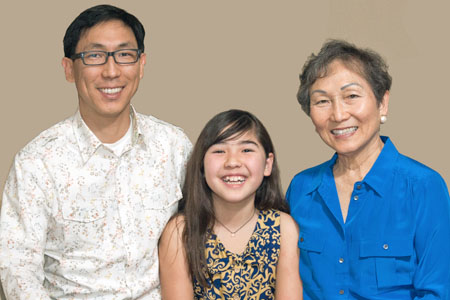
At the time of this interview, Nakano was preparing to play the grandmother in an upcoming production titled “Hanafuda With Grandma” — a fitting role for someone whose life so closely mirrors the story.
Hanafuda Hawaii began as a deeply personal project. Nakano initially wrote a how-to instructional booklet as a gift for Arielle. When friends and family began requesting copies, an idea took root: Why not pair the booklet with a deck of cards and share the game more widely?
“When I first wrote the booklet for Arielle, I thought of Hanafuda simply as a fun game I played as a child,” Nakano said. “But as I reflected on why I wanted to promote Hanafuda to a new generation at this stage of my life, I realized it could serve as a bridge — bringing families together across generations.”
The project soon became a family affair. Nakano’s son, Jason, surprised his mother by designing an original Hanafuda deck himself. His artwork became Hanafuda Hawaii’s first official deck, sold alongside Nakano’s instructional booklet.
Driven by a mission to revive interest in Hanafuda and foster connections, Nakano began teaching the game to seniors and youth groups across Hawaiʻi. She led weekly classes at the Nā Kūpuna Makamae Center before the senior resource center closed in summer 2023.
“Hanafuda gives people permission to sit together, talk story, tease each other and really connect,” Nakano said. “Age doesn’t matter once the cards are on the table.”
Teaching at the senior center brought Nakano a profound sense of joy and purpose. She recalls one student who regularly brought her young grandson to play.
“He was 8 or 9 years old, sitting in a room full of ‘old people,’ and he kept coming back,” she said with a laugh. “Now he’s 16. Watching him grow up through the game — it’s a living example of how young and old can truly relate to one another and connect through Hanafuda.”
That intergenerational bond was echoed in a reflection Arielle once wrote about the game’s impact on her life. Through Hanafuda, Arielle came to see her grandmother in a new light — as a fierce competitor.
“She wrote that anyone who plays Hanafuda with my grandmother knows how competitive she is,” Nakano said with a smile. “I never thought of myself that way — but she was right.”
The Power to Connect
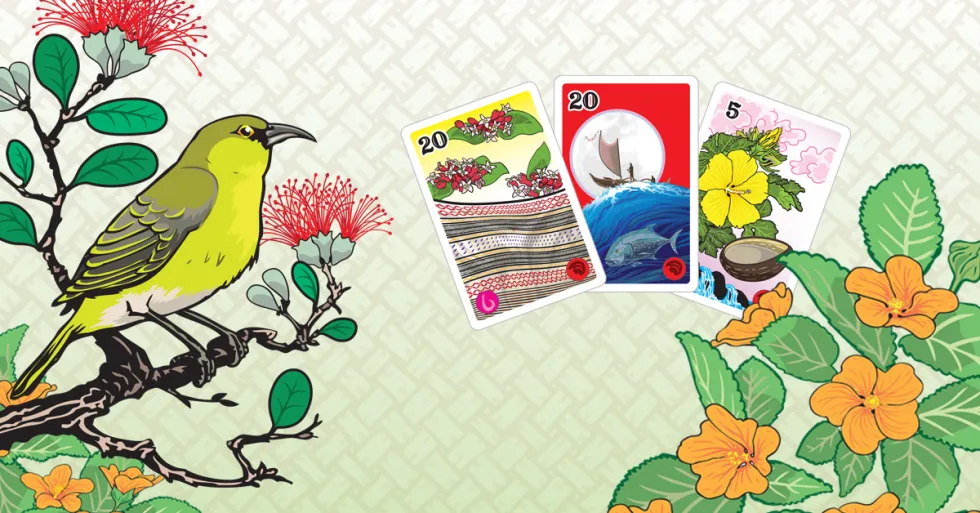
Today, Nakano hopes to extend Hanafuda’s connective power beyond families and into the land itself. With Jason’s artistic direction, Hanafuda Hawaii has released two decks inspired by Hawaiʻi’s natural landscape: “Hanafuda Nā Pua Hawaiʻi” and “Hanafuda Pilina.” Jason spent more than 200 hours researching and designing each card, drawing from native plants, animals and cultural knowledge.
“Hanafuda Nā Pua Hawaiʻi cards were made to inspire us to explore how Native Hawaiians lived in harmony with nature and helped build abundant ecosystems,” Nakano said. “Some cards reference moʻolelo — stories that reveal how Hawaiians observed natural patterns and used that knowledge to care for the land.”
Their website, Hanafuda Hawaii, offers educational resources detailing each suit, its symbolism and its connection to Hawaiʻi.
“These cards will be my legacy to Arielle,” Nakano said. “My hope is that even when she becomes a grandmother herself, she’ll remember the many happy times we shared playing Hanafuda together.”

About Jessica: Currently leading communications and community relations at FCH Enterprises, Inc. (aka @Zippys on the Internet), Jessica specialize in storytelling, community connection, and being chronically online. With a background spanning entertainment, events, and digital marketing, She thrives on bringing big ideas to life. Whether it’s launching a campaign, hosting a community event, or shaping a brand voice that resonates — if it brings people together with purpose and passion, she’s all in.