Origins of the Tanabata Festival
If you cast your gaze to the skies on a clear night in the month of July, you may notice that two of the brightest stars – namely Vega and Altair – radiate with an intensity that causes them to stand out from all the other stars in the visible constellations. That’s how you can identify them just with the naked eye.
These are the same two stars that ancient Chinese stargazers saw hundreds of years ago and created a romantic tragedy around, with the two stars representing celestial beings deeply in love with each other but separated by a hazy, milky white band of starry river we know today as the Milky Way.
Throughout the centuries, the story has taken on various versions. In the 8th century A.D., the story found its way to Japan, where it was adopted and modified by the Japanese people to make it uniquely their own (as the Japanese tend to do with foreign imports). In the Japanese version – or at least in one Japanese version – a “Weaver Princess” named Orihime spends her days weaving magical cloth from strands of stardust. Her work beautifies the skies, but it was such a solitary activity that it left her lonely and longing for friends. Her father Tentai, the Sky King, notices how sad Orihime appears to be and decides to introduce her to a handsome young cowherder named Hikoboshi for friendship.
It turns out to be a match made in heaven, and love quickly blossoms between the two. Happiness fills the young lovers’ hearts as they spend all their time together, having discovered their true loves in each other. However, Tentai, seeing that the blissful couple were neglecting their daily responsibilities, becomes angry and separates the two by restricting them to opposite sides of the sky.
Orihime obediently resumes her magical weaving but misses Hikoboshi so much that she falls into a deep depression. Tentai sees this and is so moved by his daughter’s unrelenting grief that he allows Orihime and Hikoboshi to meet again, but for only one night on the seventh day of the seventh month. (Tanabata literally means evening of the seventh.) When that month and day arrives, the eager two lovers approach each other but are stopped from getting any closer due to the barrier posed by the Milky Way (Amanogawa in Japanese, or heavenly river). Seeing this, a flock of magpies – intelligent birds similar to crows – intervene by flying as a group across the Milky Way and forming a bridge with their wings, enabling Orihime and Hikoboshi to cross over it and come together for just one night.
The Japanese Star Festival, or Tanabata, has its origins in this bittersweet tale of two separated lovers longing to be reunited. On July 7 (and in some places on August 7, based on the lunar calendar), the Japanese celebrate Tanabata with festive, hopeful activities focused on building friendships, romantic love and maintaining connections with those we care about.
One of the most beloved and recognizable of those activities is the writing of wishes on colorful strips of paper and hanging them from bamboo branches (sasatake), creating a rainbow of colorful strips (tanzaku) on the branches as they fill up with wishes. People of all ages, from little children to older adults, participate in the activity with the hope that the wind will carry their wishes to the heavens during Tanabata. Teenage girls and young women often hang wishes in the hopes of finding Mr. Right.
Tanabata in Hawaiʻi
In Hawaiʻi, the summer months are a time largely focused on o-bon festivals throughout the state, a long-held tradition brought to Hawaii by Japanese immigrant laborers during the Islands’ plantation days history and which has become a multi-ethnic celebration of sorts. Tanabata, however, is less well-known in Hawaiʻi, although still widely celebrated in Japan.
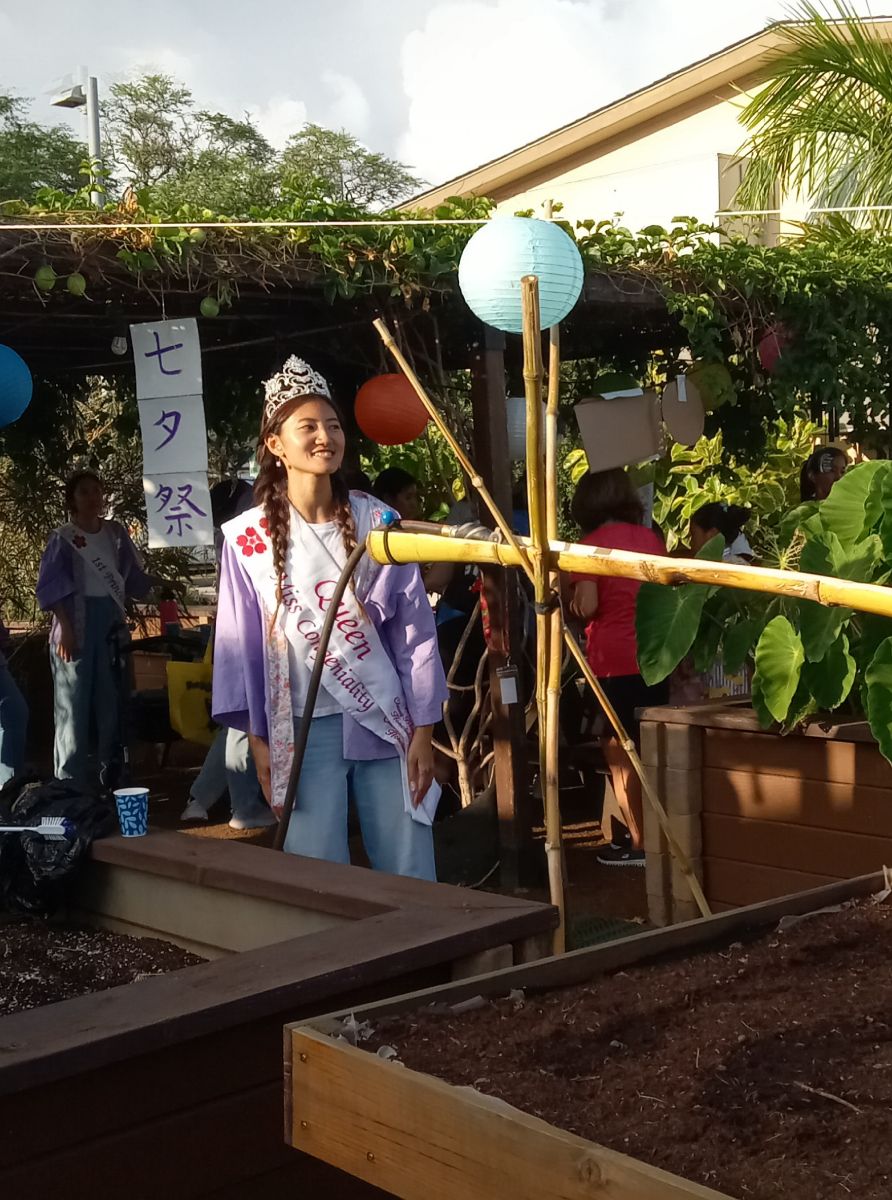
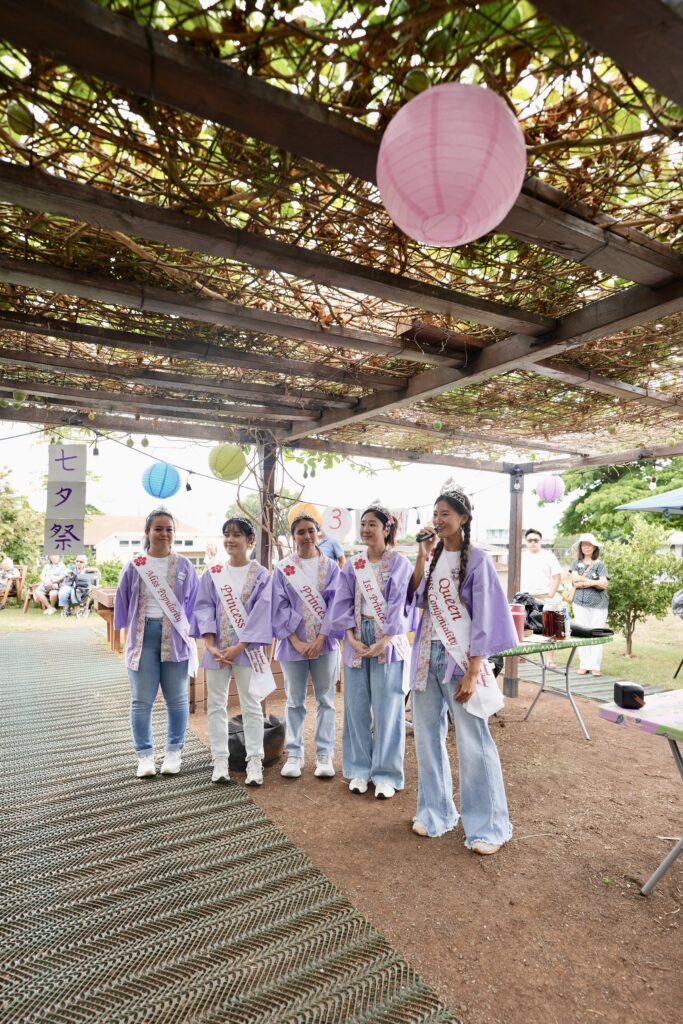
On a Thursday afternoon this past June, community members were treated to a rare Tanabata festival in Mānoa. The 74th Cherry Blossom Festival Court, led by Queen Aime Le and assisted by Cherry Blossom princesses and their supporters, organized, “Stars Over the Memory Garden: A Tanabata Celebration.” It was an intergenerational event open to all age groups. The Memory Garden, located on the campus of the University of Hawaiʻi at Mānoa and part of Ho‘ōla ʻĀina Pilipili, is an accessible garden, meaning it was intentionally designed for people of different ability levels to access and use. As such, the Memory Garden’s Tanabata festival attracted everyone from elders using wheelchairs and walkers to little children trotting happily to assorted activity stations where they made Tanabata-themed arts and crafts. Colorful lanterns were strung from above, and festive decorations evoked images of traditional Japanese culture and society.
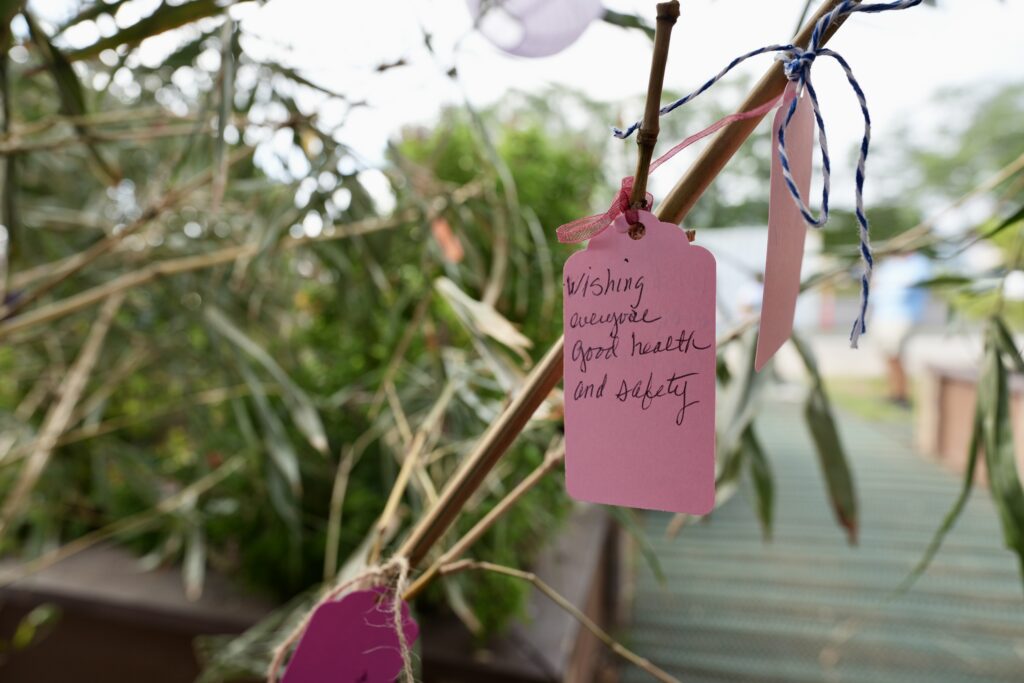
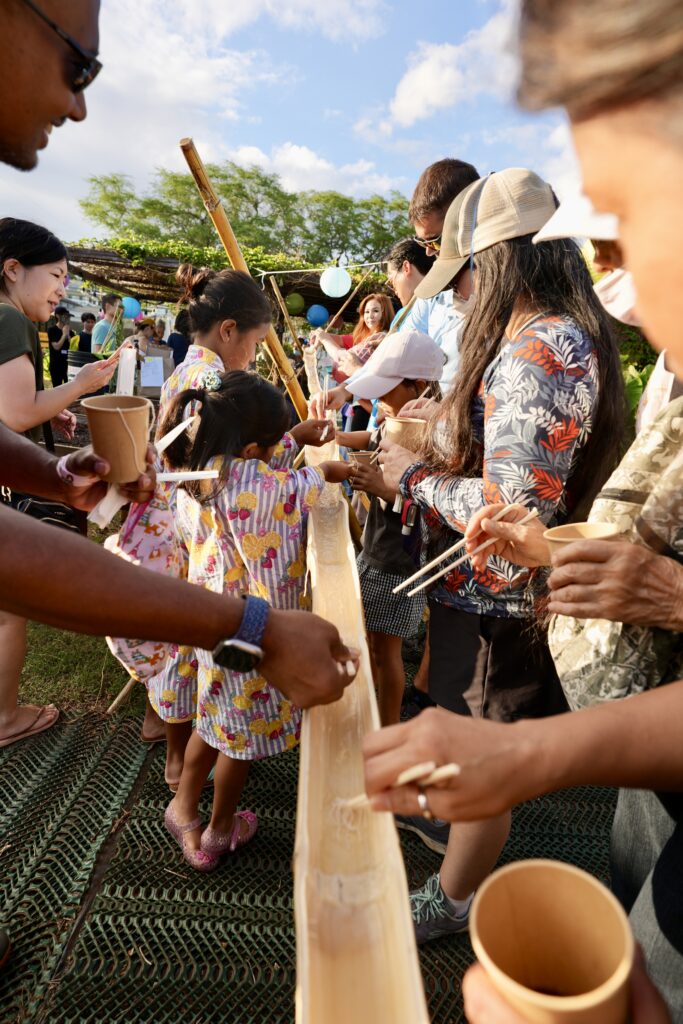
Activities included a Tanabata wish tree for hanging tanzaku; ikebana/herbal bundle making; lucky star origami folding; teru-teru bōzu making (traditional charm to bring clear skies); and the highlight of the evening: nagashi somen. Volunteers set up a hand-made bamboo contraption that allowed somen noodles to be deposited at the top of a slanted bamboo chute. Water flowing through the chute carried the noodles in a downward direction, and people standing on the sides of the chute used wooden chopsticks to grab at the noodles as they went floating by in front of them. This cherished and playful Japanese ritual emphasizes the riches of summer, nature and harmony.
A brochure handed out during the festival explained how the evening came together. “As part of the Cherry Blossom Festival program, each court member completes a community service project that reflects a cause meaningful to them. Inspired by her experiences volunteering with the Memory Garden since Fall 2025, Aime Le, 74th Cherry Blossom Festival Queen and Miss Congeniality, envisioned an event that would bring together Japanese culture, community engagement, and meaningful intergenerational connection.”
The event was a partnership between the UH Mānoa Center on Aging, the Memory Garden, and the 74th Cherry Blossom Festival Court. “We hope today’s Tanabata celebration fosters new friendships, creativity, meaningful connections, and joy for all who participate,” the brochure continued.
Other Tanabata Opportunities
If you want to experience Tanabata in Hawaiʻi, visit the Japanese Cultural Center of Hawaii’s booth at the Moʻiliʻili Summer Fest on Saturday, July 4, 5 p.m. to 10 p.m., or join the Kona Japanese Civic Association on Saturday, July 18, from 10 a.m. to 2 p.m. for their free Tanabata Festival event at Regency Hualālai Senior Living in Kailua Kona. According to a press release, “The event will feature free food, door prizes, craft vendors, keiki crafts, kids’ arm art, lauhala star weaving, wishing tree, taiko drumming, and bon dance. RSVP by calling 808-289-2625.”
If you aren’t able to attend any Tanabata events this year, just find a good spot one night in July or August to look for the Tanabata story written in the skies above. Like the Chinese and Japanese centuries ago, you’ll see Princess Orihime and her cowherder-lover Hikoboshi shimmering bright with hopeful anticipation. Pray for clear skies, as some renditions of the Tanabata story interpret rain as Orihime’s tears.
Have a festive Tanabata, and may all of your wishes on this magical night come true!

Kevin Y. Kawamoto is a former Crown Prince Akihito Scholar who studied at Nanzan University in Nagoya, Japan, and has been a longtime student of Japanese culture and society. He has been a freelance writer for more than 30 years.