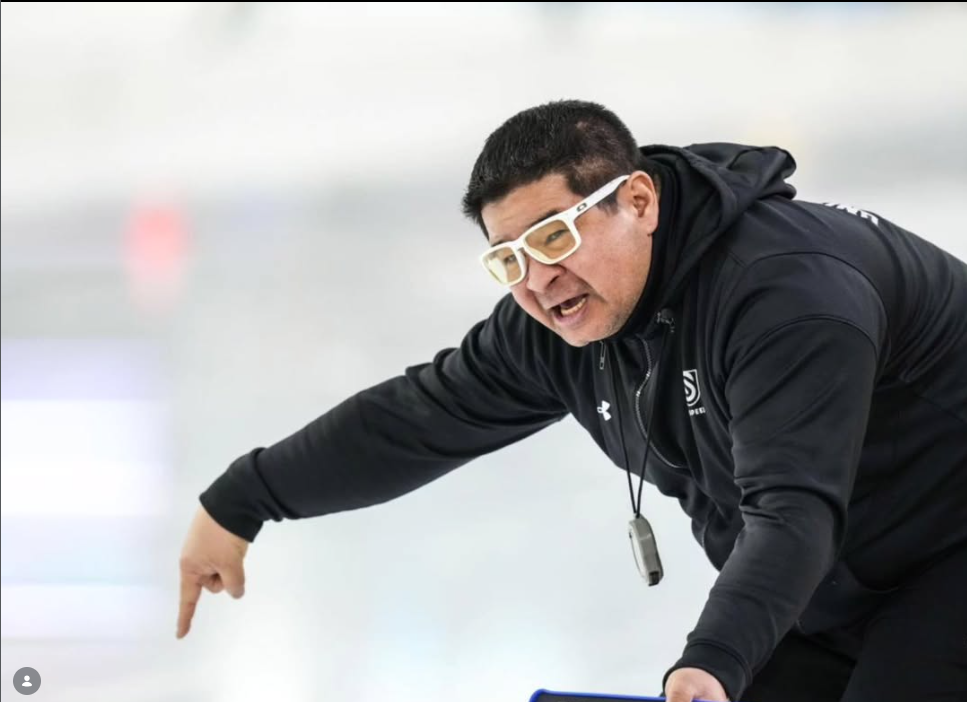
You never know which childhood moment will send a life in an unexpected direction. For Hawai‘i-born Ryan Shimabukuro, a six-year-old staring at a television screen during the 1980 Winter Olympics unknowingly stepped onto a path that would take him across the continent, around the world, and ultimately behind the boards at six Olympic Games. What began with a gold-suited speedskating hero on a TV in Honolulu grew into a lifelong pursuit—and a career still gaining momentum more than four decades later.
The Journey
Coaching Olympic long track speedskating is the kind of plot twist that rivals a Jamaican bobsled team — cue the “Cool Runnings” soundtrack. In a Zoom interview from his home in Salt Lake City, Utah, Shimabukuro tells us how it all began.
“My dad was watching the 1980 Winter Olympics on TV from Lake Placid, New York. I was 6 years old when I was watching one of Eric Heiden’s races. It must have been one of his sprint races, because I remember him in the gold suit just going really fast. I just remember thinking that it was really cool looking. You know, he was kind of like a superhero in that gold suit.”
In 1982, Ice Palace opened in Honolulu, where Shimabukuro would skate on the weekends. Shy at first, he started going with family and friends. One day after a Chuck E. Cheese birthday party, the celebration moved to Ice Palace. “We skated for about two and a half hours and I only fell once, and I really fell in love with it.” Using money earned from his paper route, he bought his first pair of hockey skates—no more rentals—and enrolled in a once-a-week speedskating class.
According to an Aug. 7, 2020 Hawaiʻi Herald article by Colin Sewake, “Shimabukuro trained for four to five hours on Saturdays and delivered the Honolulu Star-Bulletin newspaper to help pay for his skating equipment, lessons and training camps.” Shimabukuro appeared twice on “Hawaiʻi’s Super Kids” in 1987, then on “The Hawaiian Moving Company” in 1993. His skating trajectory accelerated in 1989, when he moved to Marquette, Michigan for six months to train while completing his high school sophomore year.
Shimabukuro and his parents later relocated to Wisconsin, where he graduated from Waukesha North High School in 1991 and earned a spot on the National Junior Long Track Team. He pursued the Olympics soon after, competing in the 1992 and 1994 Trials, and again in 1998—all while working as a personal trainer at Bally Total Fitness from 1994 to 1997.
During the 1998 U.S. Olympic Trials, pneumonia forced him to withdraw from the second week of competition. Faced with the financial and emotional weight of another four-year attempt, he made the difficult decision to retire. Yet before he could return to Hawai‘i, 11 skaters asked him to coach them—launching a new chapter entirely.

He served as Midwest Regional Development coach for U.S. Speedskating until 2002, then spent 12 years in Utah as National Sprint Team coach. A brief stint coaching the Japanese National Team briefly interrupted the pattern in 2014–15 before he returned to Utah again.
This year marks Shimabukuro’s 28th season in his coaching career. Asked what stands out the most, he doesn’t list medals or titles—just gratitude. “I feel very fortunate that I’m going to my sixth Olympic Games,” he says, a milestone he never imagined. “Five of them are with U.S. Speedskating.” He contributed to seven Olympic medals—three gold, two silver, and two bronze. “Each medal represents something different,” he says. “Just going into these Games has been very, very special to me.”
Hawaiʻi Roots and Values
When it comes to Shimabukuro, you can take a boy out of Hawaiʻi, but you can’t take Hawaiʻi out of a keiki o ka ʻāina. Everyone becomes “Aunty” or “Uncle,” because everyone is family. “I tell the skaters in the practices, I don’t like being called ‘coach’ because it sounds too impersonal,” he says. “Skating in the U.S. is a very, very small sport even though it’s the most successful Winter Olympic sport in U.S. history. I try to keep it family oriented.”
And his team loves spam musubi—especially the ones his wife, Hideko, makes. From staff to athletes to parents, Shimabukuro sees Team USA as one big ‘ohana.
Momentum Toward 2026
The travel schedule leading up to the Olympics is a marathon of its own. Shimabukuro rattles off the itinerary: Salt Lake City, Calgary, the Netherlands, Norway—with Germany still to come as of the writing of this article. New skaters are breaking into international standings and Opening Ceremonies are set for February 6.

San Times asked Shimabukuro what defines an Olympic-caliber athlete. “A good daily, healthy, positive routine,” he says. Eating well, sleeping well, managing time, and coming prepared. It takes years to build conditioning and resilience—not only for competition, but for life on the road. “Typically, I’d say, for a well-conditioned athlete, it takes a minimum of two years at this level to perform consistently and to get to around the top 20 mark. And then about three to four years to get into the top 10, and you’re shooting for the podium.”
Walking the Talk
After surviving a heart attack in 2019, Shimabukuro emerged with a new sense of purpose—not only for himself, but for the athletes he leads. Today, he is the embodiment of “walking the talk,” showing his skaters that excellence is not just measured in medals, splits, or Olympic appearances, but in the discipline of sustaining one’s health, focus, and well-being. Shimabukuro models the behaviors he expects of his team: he prioritizes rest, recovery, and balance, recognizing that pushing beyond limits without care comes at a cost. Whether it is making time for regular exercise that strengthens his heart, adjusting his eating habits, or maintaining mental composure during the intense winter training season, he demonstrates that elite performance should be supported—not undermined—by lifestyle choices.
Perhaps most importantly, Shimabukuro brings vulnerability and honesty into a world that often celebrates toughness above all. He openly shares his experience with the athletes he coaches, using it as a reminder that adversity can be a turning point rather than a setback. His message to skaters is simple but powerful: take care of your body now, avoid ignoring warning signs later, and embrace the kind of long-term habits that lead not only to podium finishes but to a full and healthy life. By refusing to return to the relentless, self-neglecting pace that contributed to his heart attack, Shimabukuro leads by example. He shows his athletes that strength is not only about how fast they race—it is about how well they live.
Like many great coaches, Shimabukuro once chased speed. Now, he also chases balance, gratitude, and longevity—not just for himself, but for the athletes who look to him for guidance. From a childhood inspiration in Honolulu to guiding Team USA on the world’s biggest stage, the journey has come full circle. Shimabukuro teaches his skaters to race hard, live wisely, and appreciate every lap—because sometimes the most meaningful victories are the ones that happen far from the finish line.