In an island landscape transformed by urban growth, one family’s farm has remained a steadfast reminder of Hawaiʻi’s agricultural roots. For nearly a hundred years, the Sumidas have cultivated more than watercress—they’ve nurtured a legacy.
In 1928, Kamehameha Schools Bishop Estate granted Makiyo and Moriichi Sumida a lease for five acres of land on Kalauao Springs. Nearly a century later, the Sumida ʻohana continues to uphold the tradition of growing watercress and the values instilled by their Issei ancestors.
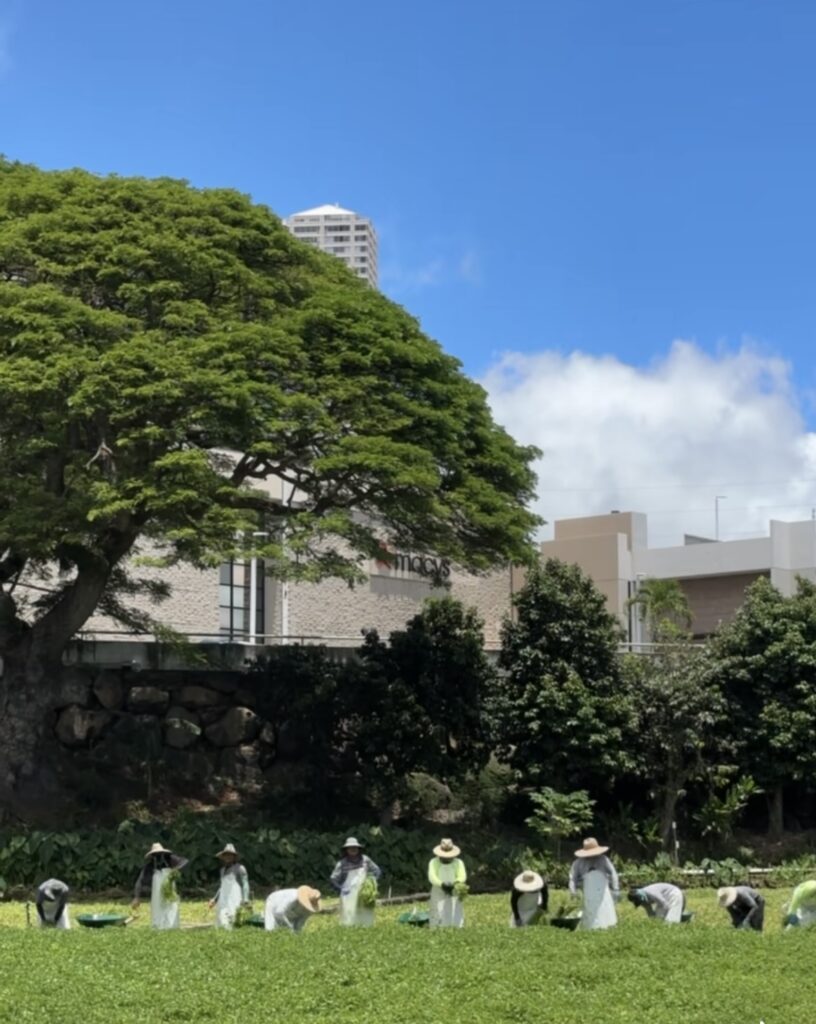
Today, Sumida Farm is one of the last watercress farms in Hawaiʻi, producing about 70 percent of the state’s recorded crop. The farm sits at 98-160 Kamehameha Highway—a vibrant stretch of green wetland surrounded by Honolulu’s growing urban landscape. The grass hale and tall coconut tree that stand atop a small patch of lawn along the highway have become familiar landmarks for drivers who pass by each day. Now in its fourth generation of family stewardship, the farm is managed by Emi Suzuki (née Sumida) and her husband, Kyle, who are in their seventh year as caretakers. “My role is to carry on the legacy built by previous generations to ensure the farm and business can continue—hopefully for more generations beyond me.”
Issei: Establishing the Farm

Makiyo and Moriichi Sumida immigrated to Hawaiʻi from Hiroshima, Japan, in the early 1900s. Before finding their calling as watercress farmers, the Sumida family worked on a dairy farm and in the sugar mills and pineapple plantations, like so many immigrants seeking opportunity in the islands. Their path eventually led them to a five-acre parcel of land in ʻAiea, Hawaiʻi—a place that would become both their livelihood and their legacy.
At a time when the sugar and pineapple industries reigned supreme across Hawaiʻi, Makiyo and Moriichi chose a different crop. Watercress can thrive only in pure spring water, and in those days, the tiny, peppery greens were among the few fresh vegetables grown locally. Kalauao Springs proved to be the perfect setting. Located near the shores of Pearl Harbor, the area is nourished by two natural springs of cool, percolating water. In ancient times, these springs sustained loʻi kalo (taro terraces); later, they nurtured rice paddies—and, eventually, the delicate greens that would define the Sumida family’s story for generations.
Nisei: Protecting the Farm

In 1952, Masaru and Norma Sumida became the second generation to steward the farm. With a blend of dedication and innovation, they expanded the family’s five-acre operation to ten acres and introduced new agricultural techniques that improved both efficiency and crop health. Pebbles laid in the spring beds helped water from Kalauao Springs flow more evenly through the fields. Narrow pathways between plots allowed workers to move wheelbarrows with ease. Masaru even designed, built, and installed a vacuum cooling machine to extend the watercress’s freshness, while a sprinkler system he implemented helped ward off the destructive Diamondback Moth.
Emi recalls that her grandfather’s greatest achievement—and his self-proclaimed ikigai, or life’s mission—was protecting the farm from being erased by development. In a true David-versus-Goliath story that unfolded throughout the 1970s, Masaru Sumida went head-to-head with Pearlridge Shopping Center in a battle over urban expansion. Developers had proposed plugging the Kalauao Springs and paving over the farmland to make way for a parking lot.
For more than a decade, Masaru worked tirelessly alongside local farmers, legislators, and then-Gov. John Burns to defend the land and preserve its agricultural use. His perseverance paid off. The Sumida family’s small, watercress-filled fields triumphed against overwhelming odds—a testament to the power of conviction and the enduring value of standing up for what you believe in.
Sansei: Reestablishing Community Connection
Masaru and Norma had four children: Charlotte, Stephen, David, and Barbara. As the eldest son, Stephen once thought he would take over the family farm, but his career in education took him in a different direction. The youngest two, David and Barbara, stepped up to manage and operate the farm as its third generation of caretakers in the early 1980s.
Trained by her mother, Norma Sumida, Barbara became the farm’s president and general manager, while David served as operations manager. David discovered a passion for welcoming Hawai‘i’s students to the farm. Emi shares, “Uncle Dave loved doing school field trips and tours. He realized and truly believed that the keiki of Hawai‘i are the future and pivoted the farm to focus on educating them about the land through school tours.
Yonsei: Carrying the Farm’s Legacy Forward
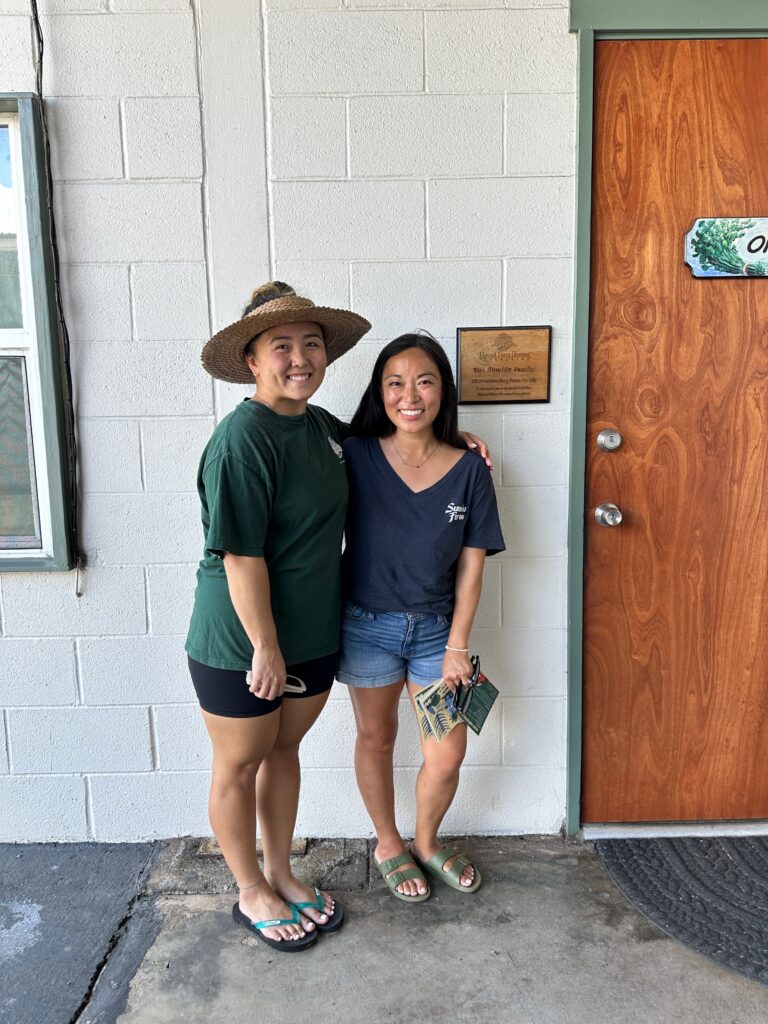
Born and raised in Pullman, Washington, Emi is the daughter of Stephen Sumida and Gail Nomura. Though raised outside Hawai‘i, she spent much of her life traveling back and forth to visit during school breaks.
In 2018, Emi and her husband, Kyle, officially stepped forward to become the fourth generation of caretakers of the farm. Emi recalls having a “lightbulb” moment while reading an airline magazine article about Hawai‘i farms. She realized that she and Kyle didn’t need to start a new business from scratch—the Sumida family’s multi-generational farm already reflected the values they cherished. They wanted to build a life and business grounded in kindness, integrity, and care for the ‘āina and community.
The values instilled in Emi by her father are ones she hopes to pass on to her own children. In a blog post about her father, she wrote: “As I grew older, and especially once I decided to take over management of Sumida Farm, the stories evolved into more serious history lessons and conversations. He wanted to ensure I understood the deep and long history of not just our farm, but of the ‘āina. He was the first to tell me, ‘Our family’s farm story is just a blip in the long history of the ‘āina; we must respect that history.’ Kyle and I have truly come to understand this sentiment, and it has become central to how we educate partners, customers, and students who visit Sumida Farm.”
By 2020, Emi and Kyle were learning all they could from Barbara and David to prepare for the transition. But when Barbara suddenly became ill and passed away in February 2020—just as the COVID-19 pandemic began—the couple’s nine-year transition plan quickly became a two-year one.
Reflecting on the experience, Emi describes it as “unexpected.” She shares, “There are days when it’s challenging and hard, but I wouldn’t change it. I never thought I would be in this position… I’m really fortunate that not only do I love it, but I also have Kyle—my husband, business partner, and coworker.”
The pandemic, she says, was a blessing in disguise. It gave their family time to work side by side on the farm while their children—Clare, Alice, and Margaret—attended school virtually from Hawai‘i. “This is one of the most fulfilling things I’ve ever done,” Emi reflects. “Nothing I do for corporate America will ever touch the impact we get to make through carrying on the legacy of the farm.”
Since stepping into their new roles, Emi says, “The farm embodies so many things we care about—the environment, the people, food, nourishment, education, art. There are not many jobs in this world that align so completely with your values. I love that we get to carry that on.”
Looking Ahead to the Next 100 Years

Reflecting on almost 100 years of history, Emi is in awe. She explains that “thinking about the sacrifices made by previous generations, it’s inspiring to see… our family was not rich–they were hardworking, working-class people, who ensured that they made the right decision so that their children could build their own lives here. I think about that and the privilege we have now as Yonsei, all that we have is built on the sacrifices of the previous generations, and I also think about the future generations… That was really what inspired Kyle and me to step up–if no one steps up to face the challenge today, then no one else will.”
She explains that “the farm is this dream that Kyle and I are chasing–my kids are just along for the ride… I hope that in the long run, they realize how unique and special this upbringing is and that they look back fondly on it.” Emi smiles as she recounts what it’s been like watching her girls experience life on the farm.
“The coolest part is when they get to share the farm with their friends–and I think they see it (the farm) with new eyes.” Suzuki says she thinks about the future generations and hopes that they “see as much of the beauty and unique opportunity that is here at the farm and how special it is so that they carry it on.”
The family is looking forward to celebrating the farm’s centennial anniversary in 2028. Reflecting on almost 100 years of history, legacy, and stories, Emi beams that her family is excited to continue sharing the farm with the community. “That’s the cool thing about the farm–it’s so much bigger than just my family, and even the community we’re aware of… it humbles you really quickly–sometimes I’m not even aware of how much this farm means to other people!”
As for the future of the farm, the family hopes to continue sharing and honoring the farm’s stories and its legacy, but with a 21st-century twist. “Through social media and through all the awesome collabs with other local businesses, we’re able to expand our community outside of school tours through social media platforms.”
“Our mission is to nourish the islands… we purposefully don’t include watercress or farming in that statement because where we’re going in the world–there’s a lot outside of our control. And without that true control over the future, we have to be realistic and know that there might be a day where the springs dry up or the sun is too hot, or there might be a day where our farm is covered in salt water. Because of that, our goal is to nourish the islands, and there are a lot of ways we can do that, especially by sharing the farm’s story; whether that’s through education, a storefront; there are a lot of ways that we can continue what we’re doing but in a little bit of a different way. I hope that, at least through my generation, we can continue farming and build on that.”
When Emi and Kyle first began dreaming about what they envisioned managing the farm and what they wanted their legacy to look like, the couple says they had a list of dreams and goals for collaborations, partnerships, and people they wanted to meet and share the farm with. “We feel we are lucky to be able to say we’ve been able to tick off a lot of what we set out to do.”
Take a gander at Sumida Farm’s Instagram (@sumidafarm) and you’ll see that they have just under 20,000 followers–an impressive count considering they only started posting four years ago. The farm’s virtual feed is full of colorful images and videos ranging from shared stories to recipes that they feel are important to their family and community. A fan-favorite of the farm’s followers are recipes shared by Chef Elijah, the farm’s operations assistant. In addition, the farm’s feed features personal stories and photographs from the Sumida family, and recollections and connections to famous chefs of Hawaii–Colin Hazama, Jeremy Shigekane, and Mark Noguchi, all of whom share their own personal favorite watercress recipes and stories of the importance the farm played in their lives. Through the years, the farm has been able to partner with local businesses like Beer Lab, Zippy’s, Nature Waikiki, Feast, Kaimuki Shokudo, Pig and the Lady, to create unique island-inspired dishes, beers, and even ice cream!
“The biggest honor and most amazing part about what I get to do is–I get to work with some of the hardest-working people in the world–the best crew and the best employees you could ever ask for. In addition to the people we work with, the people we’ve met have been amazing!”
With so much admiration and respect for their team and community, Suzuki says that “none of this is possible without support from the community and people who care about the farm–they don’t have to care about me or my family–just the farm, because without their support we cannot continue–and that’s true not just for our small business or farm but for all small businesses and farms–the support of the community and the collective desire that we can all continue on is so important, I hope that we can continue that and keep going.”
Eat Plenty Watercress. Check out the farm’s Instagram and website – a treasure trove of knowledge, from personal notes to ‘ono family recipes. Sumida Farm shares recipes and stories about the farm’s 100-year history. sumidafarm.com or @sumidafarm on Instagram.
Check out the many ways to serve up watercress on Kau Kau Chronicles https://www.kaukauchronicles.org/search?q=Watercress.

About Jessica: Currently leading communications and community relations at FCH Enterprises, Inc. (aka @Zippys on the Internet), Jessica specialize in storytelling, community connection, and being chronically online. With a background spanning entertainment, events, and digital marketing, She thrives on bringing big ideas to life. Whether it’s launching a campaign, hosting a community event, or shaping a brand voice that resonates — if it brings people together with purpose and passion, she’s all in.