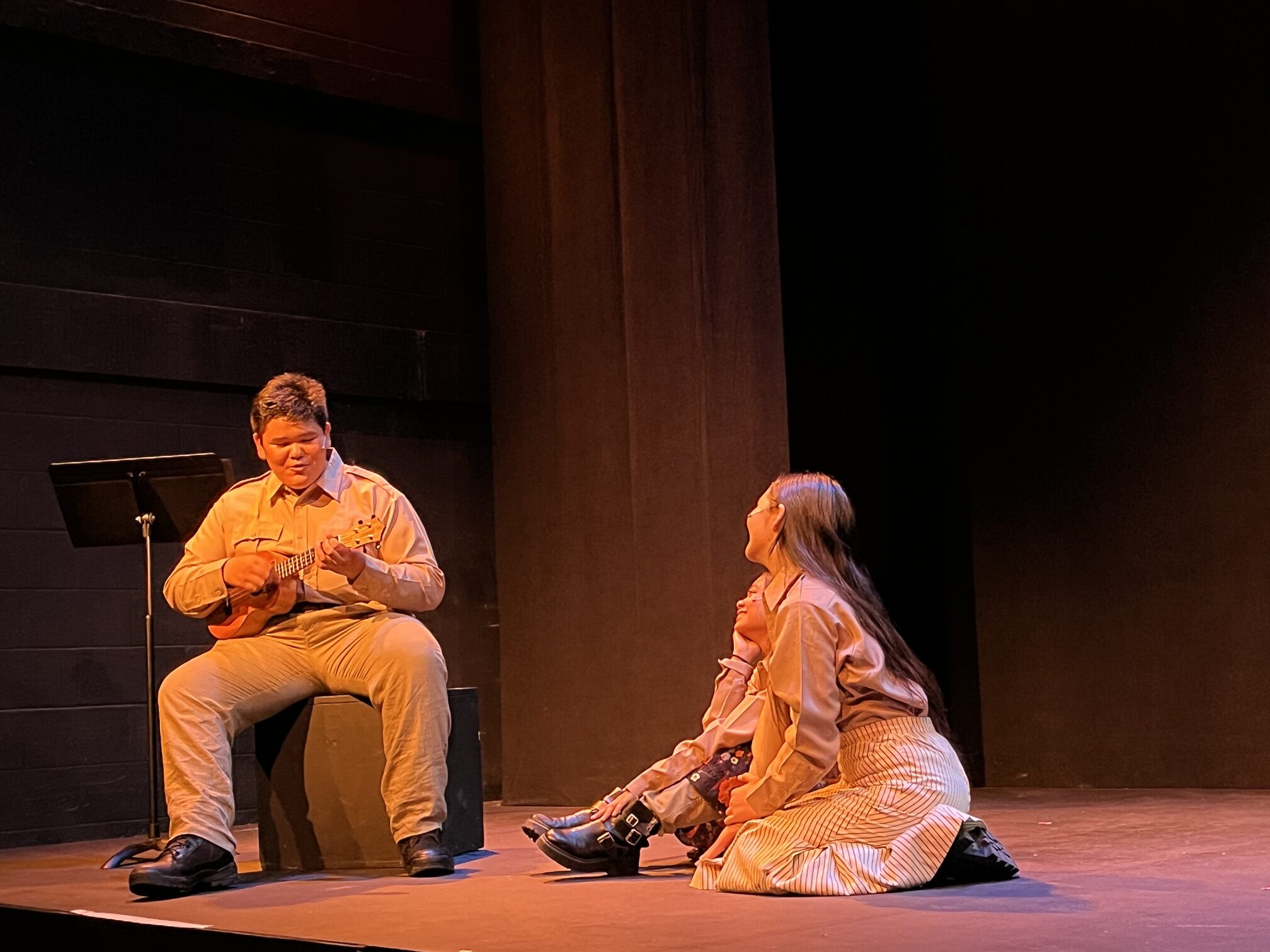
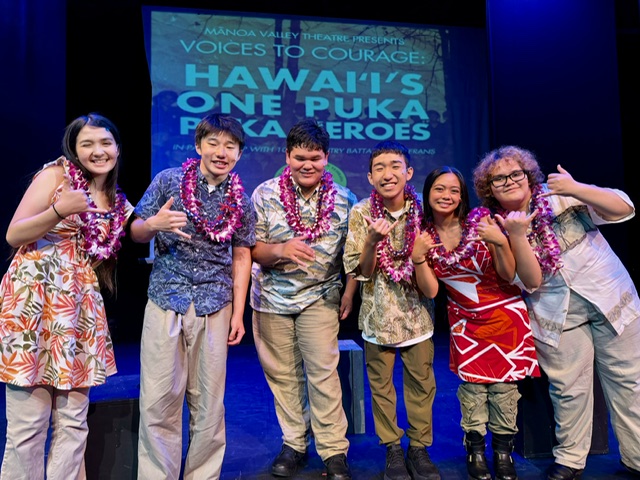
If you were among the fortunate who got a ticket to one of the two sold-out performances of “Voices to Courage: Hawai‘i’s One Puka Puka Heroes” in mid-July, you were indeed lucky … for you saw six bright, talented and hard-working high school students bring stories of Hawai‘i’s 100th Infantry Battalion to life on the stage of Mānoa Valley Theatre.
The student playwright-actors were 16-year-old juniors Maggie Inouye (Mililani High) and Jack Nitta and Kaileah Pagtulingan (Mid-Pacific Institute); 15-year-old sophomores Myles Rivera Hilton (Campbell High) and David Rhys Tamura (‘Iolani School); and 14-year-old freshman Kazuya Nakagawa, who is homeschooled. Only two students had family ties to 100th Battalion or 442nd Regimental Combat Team soldiers: Kazuya, whose great-grandfather, Yatsuji Nakagawa, served in the 100th Battalion, and Maggie, whose grandfather, U.S. Sen. Daniel Inouye, who fought with the 442nd RCT.
Mānoa Valley Theatre artistic director Rob Duval, a former drama education teacher at ‘Iolani School and Mid-Pacific Institute (MPI), guided the students through the project. He had previously worked with students on developing performances based on the subjects of hospice care and military experiences.
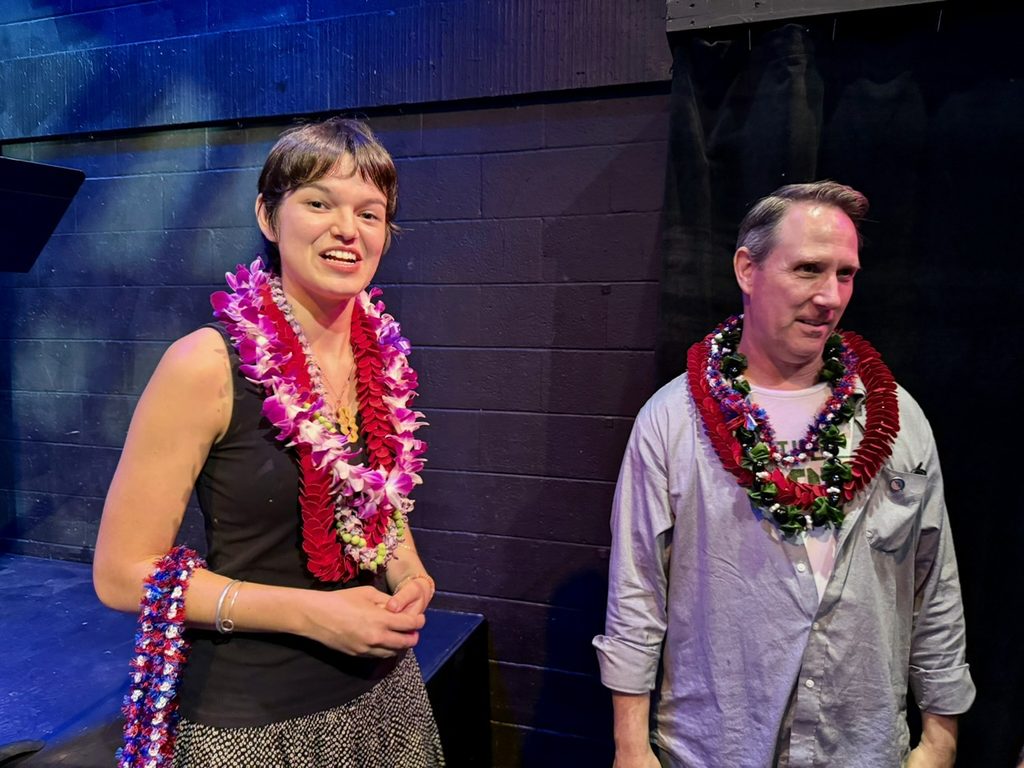
In February, Duval began contacting other drama educators he knew, informing them of the 100th Battalion project and inviting their students, ages 13 to 18, to apply. Of the nine who initially expressed interest in the program, three eventually withdrew, leaving Duval with six students.
“I’m really happy that these six signed up for it. They all took a leap of faith, and we all took a leap of faith together,” he told the audience.
Duval’s former student, Eva Rogers, served as the production’s assistant director. The New York University sophomore and Mid-Pacific Institute graduate was home for the summer and volunteered her time and assistance in return for the experience.
The “Voices to Courage” project was conceived of by two longtime and recently retired friends, Alan Suemori and Mariko Miho. Suemori had been a history teacher at ‘Iolani School, where he often taught Asian American history. Miho had worked for the University of Hawai‘i Foundation, helping prospective donors flesh out causes and projects they wanted their philanthropy to support. The two were concerned that Hawai‘i’s young people were going forward in their lives knowing little to nothing about the sacrifices of the World War II generation and how their sacrifices had created opportunities for people like them and the generations that would follow.
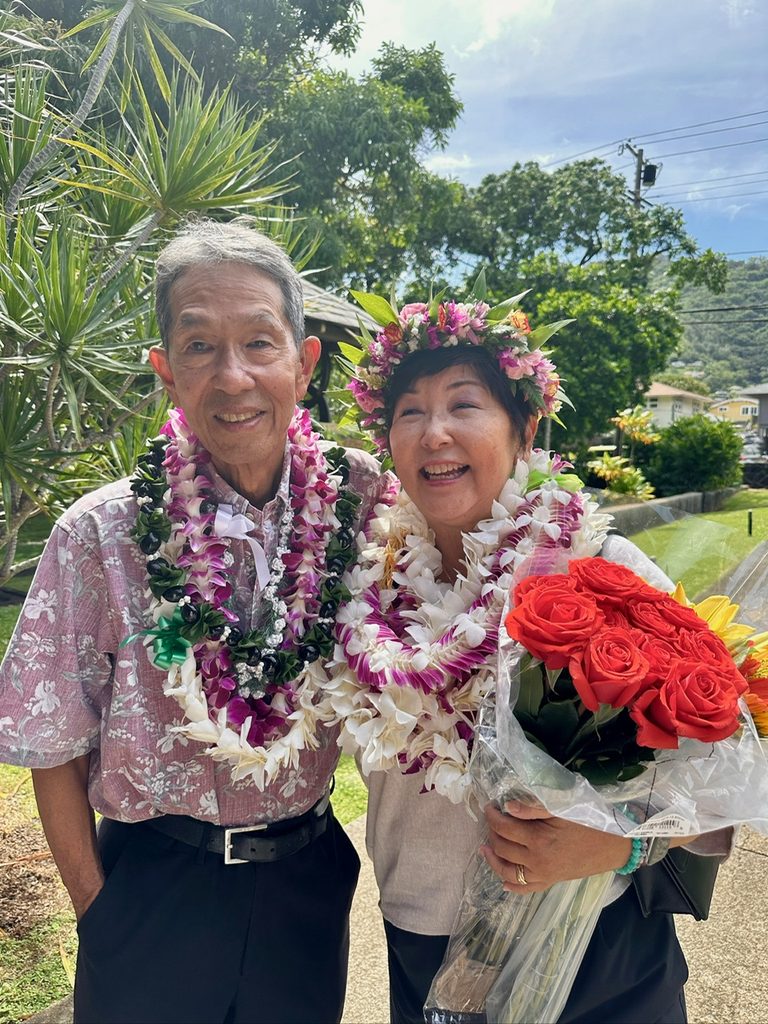
Miho understood it well. Her father had served in the 442nd Regimental Combat Team, which joined the 100th in Italy in June 1944, nine months after the 100th entered battle in Italy. Miho said her father reminded her often that the 100th Battalion soldiers were the 442nd’s “big brothers.”
“Throughout my career, especially at the university, I looked for ways to honor them. But only in retirement could I truly explore their lives through the things I love most: arts, culture and theatre. ‘Voices to Courage’ is my way of honoring and remembering them,” she said.
Suemori felt it important that the students also learn about the 100th Battalion soldiers’ origins. Although most had grown up in ethnically segregated sugar plantation camps in rural parts of the territory, the public schools they attended brought together Japanese, Hawaiian, Chinese, Portuguese, Filipino and even haole kids. They played marbles and baseball with each other and ate lunch together at school. From these interactions grew friendships.
Although most of the One Puka Puka soldiers were of Japanese descent, about two dozen were Native Hawaiian, or hapa — of mixed heritage: Japanese-Hawaiian, Japanese-Chinese, Japanese-Filipino, Japanese-Portuguese. A few of the men who shipped out with the 100th soldiers weren’t Japanese at all, but they didn’t want to be separated from a hapa cousin they were especially close to, even if it meant going to war with him.
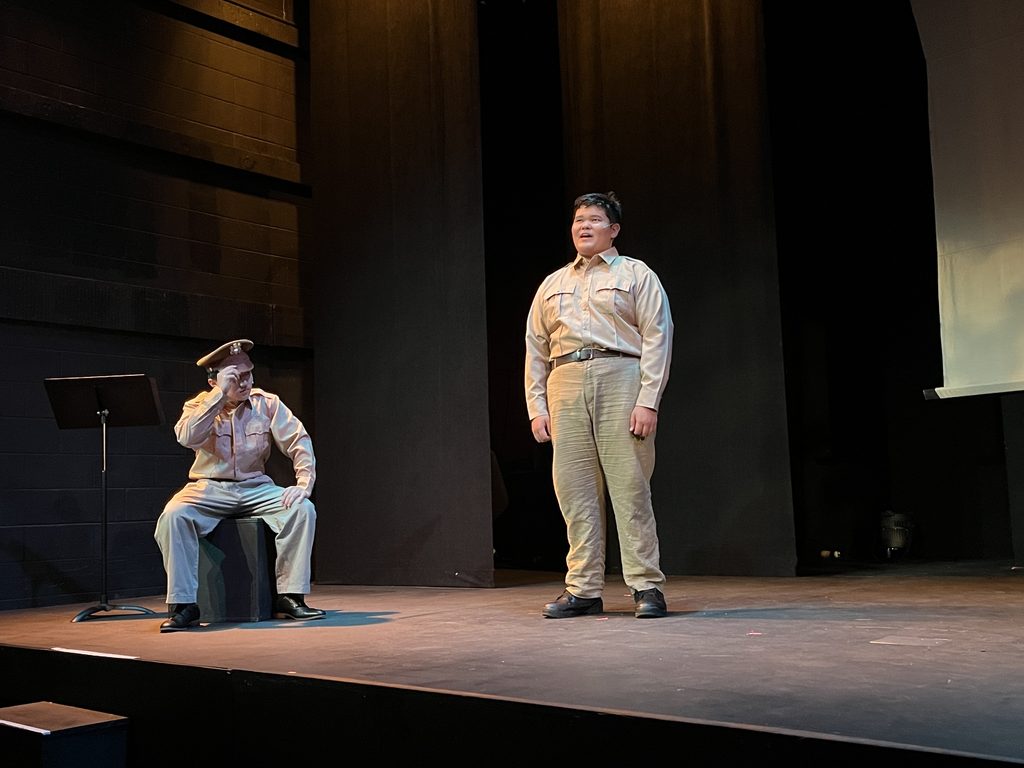
The first two Japanese American soldiers killed in action were 100th Battalion soldiers who died within hours of each other on Sept. 29, 1944, just a week after entering combat in Italy. Many more fell — killed in action or injured — so many that the 100th came to be known as the “Purple Heart Battalion.” The students needed to know that many had given their lives so that they could live free and with the opportunities they enjoy today.
One day, Miho and Suemori were discussing their passion project at a Mānoa coffee shop when in strolled Mānoa Valley Theatre’s Rob Duval to get some coffee. They shared their idea with him, and the rest is history.
“These stories anchor the Hawai‘i community to something deeper and more timeless that will endure far beyond the present moment,” said Suemori. “What gives me hope is that our play is evidence of what can be accomplished if people come together and care about each other and what will happen to the next generations in the years to come.”
Step by step, the project began coming together with the support and cooperation of the 100th Infantry Battalion members. With only a handful of 100th soldiers surviving, it became clear to Miho and Suemori that the veterans’ daughters and sons would have to share memories of their fathers and their wartime experiences. Not all of the fathers had shared their experiences; most, in fact, had not. But no one knew their father’s character better than their children, and that was something worth sharing with the students.
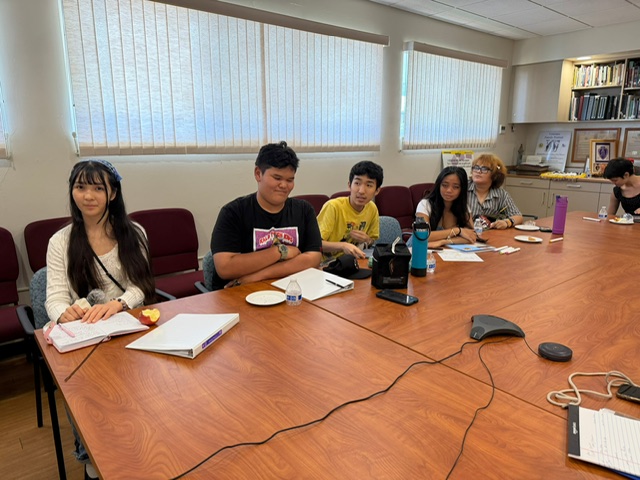
The value of meeting the veterans’ descendants and listening to their memories was not lost on Maggie Inouye. “I think meeting the descendants in person as opposed to just reading the stories really made a difference, especially being in that 100th clubhouse, which, as we said in the show, is kind of a sacred space. You step in there and you feel the power … You feel the stories that have lived there and continue to live on there. It really helped us understand the gravity of some of these stories.”
Learning the individual stories of discrimination “really makes it feel a lot more real … it humanizes it; it makes it seem less far away,” she added. Guided by Duval, the students began retelling those stories in a script they wrote as a team. The production was titled, “Voices to Courage: Hawai‘i’s One Puka Puka Heroes.” When the script was finally completed, they moved into daily rehearsals at Mänoa Valley Theatre.
Among the stories featured in “Voices to Courage” are:
- Edward Ikuma’s memories of June 5, 1942, the day the 1,432 mostly draftees in the Hawaiian Provisional Infantry Battalion sailed out of Honolulu Harbor on the U.S. transport ship Maui, not knowing where they were headed. A week later, they sailed under the Golden Gate Bridge and docked in Oakland, Calif., where they were renamed the 100th Infantry Battalion (Separate). Ikuma also remembered returning from the war, again, with no one there to greet him.
- The 100th Battalion’s Aloha baseball team’s games at Camp McCoy, Wis., where the unit was stationed, and in the towns of Lacrosse and Sparta, where the haole girls swooned over the ‘ukulele-strumming 100th Battalion musicians known as the Hawaiian Serenaders.
- “Voices to Courage” also captured the 100th’s morale officer, Capt. Franklin Kometani, making his pitch at Camp McCoy to collect $2 every payday for a future clubhouse that the veterans would build after returning home from the war. That clubhouse, the 100th Infantry Battalion Memorial Building, often referred to as Club 100, was built at 520 Kamoku Street in Mö‘ili‘ili-McCully. ‘Iolani School established its campus across the street a year later.
- Lt. Col. Farrant Turner’s appeal to his superiors to allow the 100th Battalion to fight in Europe rather than be relegated to guard duty.
- Returning home after the war, those who survived were determined to make positive changes in Hawai‘i by getting involved in politics and opening businesses such as Central Pacific Bank.
These brief vignettes and others provided enough information for the audience to understand the unit’s story.
“I thought the students did an exceptional job,” said Ruth Otake, a retired massage therapist who attended the July 12 show. “I got the impression (from the performance) that they understood what the soldiers of the 100th experienced and they could relate it to themselves, their families and their communities.”
Just three weeks earlier, it was a story the students barely knew. Myles Rivera Hilton said he had “zero knowledge” of the 100th Battalion story. “All I knew about World War II was really just the Pearl Harbor bombing. I knew nothing about the 100th until … we started working on this,” he said in a post-performance Q&A with the Saturday audience. “It’s so important. It’s something that I should have known.”
Maggie Inouye said she had learned a little bit about the 100th Battalion in school, but not the individual stories, “so hearing those was really powerful for me and all of us, as well.” Learning the 100th’s history made David Rhys Tamura realize that “we can hold our heads higher.”
Kaileah Pagtulingan saw parallels between the “hatred and discrimination” in today’s society and what Japanese Americans faced following the Pearl Harbor bombing. Maggie Inouye concurred. “There are so many divides we still need to conquer and we can take how these men faced discrimination and how we face discrimination in our own lives and the lives of others,” she said.
Kaileah, who hopes to study acting, said interviewing the descendants “helped us find our characters a bit more.” She shared her experience portraying Elsie (Higa) Yoshimura, daughter of 100th Battalion veteran Taro Higa. After recovering from his injuries, Higa had gone to Okinawa, his ancestral homeland, where the Battle of Okinawa was still being waged. There, he joined Military Intelligence Service soldiers attempting to persuade Okinawan civilians to come out of the caves where they had taken refuge before those caves were sealed and firebombed.
“It was such a good experience learning her (Yoshimura’s) stories,” she said. “I was rewatching her interview multiple times, learning the way she talked and the way she acted, so it only led to a better understanding of her story and her character.”
Kaileah also studied the character of Joy (Takeshita) Teraoka, another real-life she portrayed. “Personally, learning about these stories inspired me, especially Joy Teraoka’s story.” As Joy Takeshita, she had been a singer with several big bands in incarceration camps during the war. After the war, she married 100th Battalion veteran Denis Teraoka, who had grown up on the Big Island.
“I’m a singer myself,” said Kaileah. ”Learning her story about how her music gave these people kind of a light within the darkness during those harsh times. It made me realize how grateful I am to be present in this lifetime …”
Mary Kunmi Yu Danico, director of the University of Hawai‘i at Mānoa’s Center for Oral History, said the performance exceeded her expectations. “The ways in which the students interpreted the stories of the 100th Battalion and their descendants was not only touching, personal and reflective, but it also showed the care and a sense of respect that the students show toward the stories,” Danico said.
“It’s incredible that in such a short period of time, these young people from age 14 through 16 were able to capture the life stories of those who went through an incredible ordeal, lost many friends and returned home to a country that saw them as ‘friendly enemies.’” The writing, production and the use of videos showed a thoughtful interpretation of the stories, she added.
Danico saw people in the audience wiping tears from their eyes at various points in the play. “This story taught so many of us the importance of ensuring that we preserve the memories of those who sacrifice so much. I know that the students learned a great deal from this summer experience. They gave a tremendous gift to the audience,” she said.
Chad Taniguchi, retired Hawai‘i Bicyling League executive director and former UH Center for Oral History director, said it was “extremely gratifying” to see the students grasp the facts and stories of the 100th Battalion. “I wish all people, especially the young, could see the play or a video of it,” he said.
“I think that this experience really underscored to me the importance of keeping these stories alive,” concluded Maggie Inouye. “No one truly dies until their story dies, until their memory dies. I think keeping that memory alive is a great way to teach us to unlearn our hatred …”
In April 2020, Karleen Chinen retired as the Editor of The Hawai‘i Herald after 16 years of leading the semimonthly publication that covers Hawai‘i’s Japanese American community. Her book, Born Again Uchinanchu: Celebrating Hawai‘i’s Chibariyo! Story, chronicling Hawai‘i’s Okinawan community from 1980 to 2000. Chinen previously served as a consultant to the Japanese American National Museum and was part of the JANM team that took its traveling exhibition, From Bento to Mixed Plate: Americans of Japanese Ancestry in Multicultural Hawai‘i, throughout the neighbor islands of Hawai‘i and to Okinawa for its international debut in November 2000.